
The volume of a triangular-based pyramid is calculated using the formula V = (area of the base x height) / 3. This factor of 1/3 often surprises people: why divide by three, and not by two or four? The answer is not based on an arbitrary convention. It stems from a verifiable geometric property that can be demonstrated without integral calculus, provided you manipulate the right solids.
Cutting a prism into three pyramids of equal volume
The most compelling demonstration starts from a familiar object: the right triangular prism. This solid has two identical triangular faces connected by three rectangular faces. Its volume is simply calculated by the area of the base multiplied by the height.
The remarkable fact is that you can partition this prism into exactly three pyramids. Each shares the same triangular base and height as the prism, or different bases and heights but with the same product.
By cutting the prism along its internal diagonals, you obtain three tetrahedra of equal volumes. The proof relies on pairing these pyramids two by two: two of them share a common base and have the same height, thus the same volume. It is then shown that the third is also equal to one of the first two, by a symmetric argument. Since three identical pyramids reconstruct the prism, each represents one third of its volume.
Understanding the volume formula of a pyramid involves this decomposition, which makes the factor of 1/3 tangible rather than dogmatic.

Parallel sections and area proportional to the square of the distance
Another approach sheds light on the same result from a different angle. It is based on the observation of horizontal sections of a pyramid.
Take any pyramid and cut it with a plane parallel to its base, at a fraction k of the total height measured from the apex. The resulting section is a figure similar to the base, but reduced: its linear dimensions are multiplied by k, and its area is therefore multiplied by k².
This quadratic relationship has a direct consequence on the volume. In a prism, each horizontal section has the same area as the base (constant area). In a pyramid, the area of the sections grows as the square of the distance from the apex. The “amount of material” accumulates more slowly in the pyramid than in the prism.
- In a prism, the area of each slice is constant: area = A (the base), regardless of the level
- In a pyramid, the area at a fraction k of the height from the apex is A x k², which concentrates the volume towards the base
- The ratio of the cumulative volumes of the prism and the pyramid converges exactly to 3, giving the factor of 1/3
For those familiar with integral calculus, it is the integral of k² from 0 to 1 that gives 1/3. The argument by sections makes this result visible without going through the integral: the area grows in k², thus the volume is one third of the prism.
Triangular-based pyramid or square-based pyramid: the factor 1/3 is universal
A common confusion is to believe that the 1/3 depends on the triangular shape of the base. This is not the case. The factor of 1/3 applies to any pyramid, whether its base is a triangle, a square, a pentagon, or even a circle (in which case we refer to it as a cone).
The reason is the same in all cases: the pyramid is a solid whose sections parallel to the base decrease in area according to the square of the distance from the apex. This geometric property does not depend on the number of sides of the base.
What changes from one pyramid to another is only the calculation of the area of the base. For a triangular base, this area is (base of the triangle x height of the triangle) / 2. For a square base, it is the side squared. The complete volume formula incorporates this area, but the 1/3 remains unchanged.
Height of the pyramid and confusion with the apothem
A classic trap deserves to be pointed out. The height that appears in the volume formula is the perpendicular distance between the base and the apex, measured at a right angle to the plane of the base. This height does not correspond to the apothem, which is the distance between the apex and the midpoint of an edge of the base (measured along a lateral face).
Using the apothem instead of the height skews the result. The apothem is always greater than the true height, except in the degenerate case where the pyramid is flat.
Why the geometric demonstration is more convincing than a learned rule
Stating “we divide by three” like a cooking recipe poses a pedagogical problem: as soon as a student or a professional encounters an unusual solid, the memorized rule is no longer sufficient. The decomposition of the prism into three pyramids, or the analysis of the sections, provides transferable reasoning.
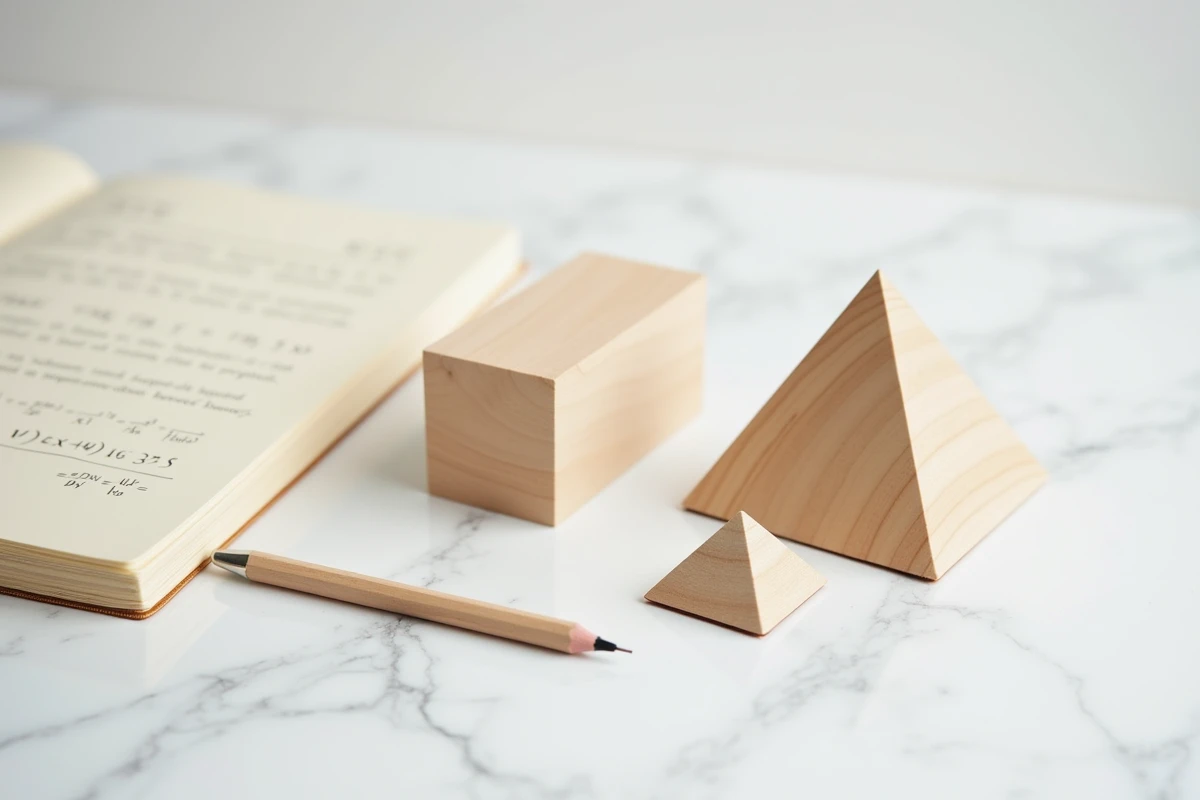
The decomposition into three tetrahedra physically shows that three identical pyramids fill a prism. This can be verified with cardboard models or 3D printing. The argument of sections, on the other hand, generalizes to the cone and any pointed solid.
- The decomposition into three pyramids: visual proof, suitable for concrete manipulation, but limited to triangular-based prisms as a starting point
- The argument by parallel sections: more general proof, applicable to any pyramid and the cone, but more abstract
- Integral calculus: formal proof that unifies the two approaches, accessible from high school
These three paths lead to the same factor of 1/3. Their complementarity enhances understanding: each illuminates a different aspect of the relationship between a pointed solid and the prism (or cylinder) that encompasses it.
Thus, the factor of 1/3 is neither an arbitrary choice nor a shortcut notation. It reflects a fundamental property of the geometry of solids: any solid that linearly tapers to a point occupies exactly one third of the volume of the corresponding prismatic envelope. Retaining this idea eliminates the need to memorize the formula, as it can be reconstructed from the volume of the prism.