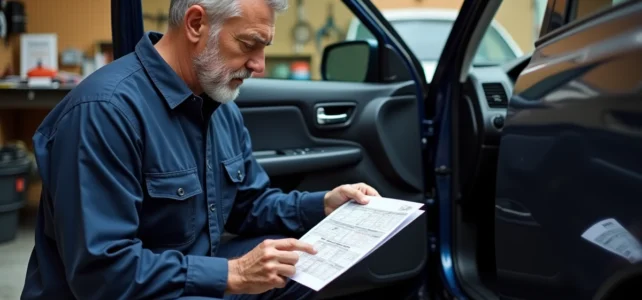
It’s a rushed morning, the remote control isn’t triggering anything, and all the doors remain locked. Before considering a card issue or a dead battery, the fuse for the central locking should be checked first. This small component protects the central locking circuit from surges, and when it fails, the entire system goes silent. Locating the correct fuse and replacing it rarely takes more than ten minutes, provided you know where to look.
Unfindable central locking fuse: when the diagram doesn’t match reality
We often start by opening the fuse box cover expecting to find a clearly labeled location. On some recent vehicles, the theoretical position of the central locking fuse is well indicated on the diagram, but the physical location is empty. This is documented on several Ford Focus 3 models around 2010, where position 38 is noted for central locking without any fuse installed.
The explanation lies in the evolution of electronic architectures. On many recent models, the central locking fuse is no longer a dedicated component but a function integrated into the BSI or BCM module. This control unit simultaneously manages lighting, wipers, power windows, and locking. When you come across an empty location, the central locking therefore goes through this module, and the diagnosis changes completely.
Before searching everywhere, you can check the central locking fuse on Carfully to identify the type of protection used according to the brand and model. This check prevents wasting time on a fuse that simply doesn’t exist in your vehicle’s configuration.

Identifying the correct fuse in your car’s fuse box
On vehicles that still use a physical fuse for central locking, there are two main locations: the cabin fuse box (under the dashboard, often on the driver’s side behind a cover) and the box in the engine compartment.
Common labeling by manufacturers
The central locking fuse rarely bears the label “central locking” in full. On several recent Toyota Yaris models, it can be found under the labels DOOR, LOCK or C/D LOCK in the cabin box, usually accessible under the steering wheel. This labeling convention makes it easy to locate even without the owner’s manual on hand.
For vehicles from other brands, the names vary. Here are the most common labels to look for on the fuse box cover:
- DOOR or DOOR LOCK: common labeling on Japanese and Korean models, covers the door locking circuit
- C/D LOCK or CENTRAL LOCK: direct designation of central locking, frequent on Toyota and some European models
- BCM or BSI followed by a number: particularly on French vehicles, the fuse powers the intelligent service box that manages central locking among other functions
When the manual is missing
Without manufacturer documentation, you can often find the diagram engraved or printed on the inside of the fuse box cover. If this diagram is unreadable or absent, a search using the exact model reference and year usually provides access to the diagrams. However, field reports show that these public diagrams do not always align with the actual configuration of the vehicle, especially on models produced at the end of the cycle.
Testing and replacing the central locking fuse
You’ve found the suspect fuse. The temptation is to look at it through transparency to see if the filament is broken, then put it back if it seems intact. This visual method is not reliable.
Why visual inspection is not enough
A fuse can appear intact to the naked eye while being broken, especially in the mini or micro sizes used on modern vehicles. The filament is so fine that a partial break remains invisible without magnification. Recent diagnostic guides consistently recommend testing with a multimeter in continuity mode: place one probe on each terminal of the fuse, and if the device doesn’t beep, the fuse is blown.
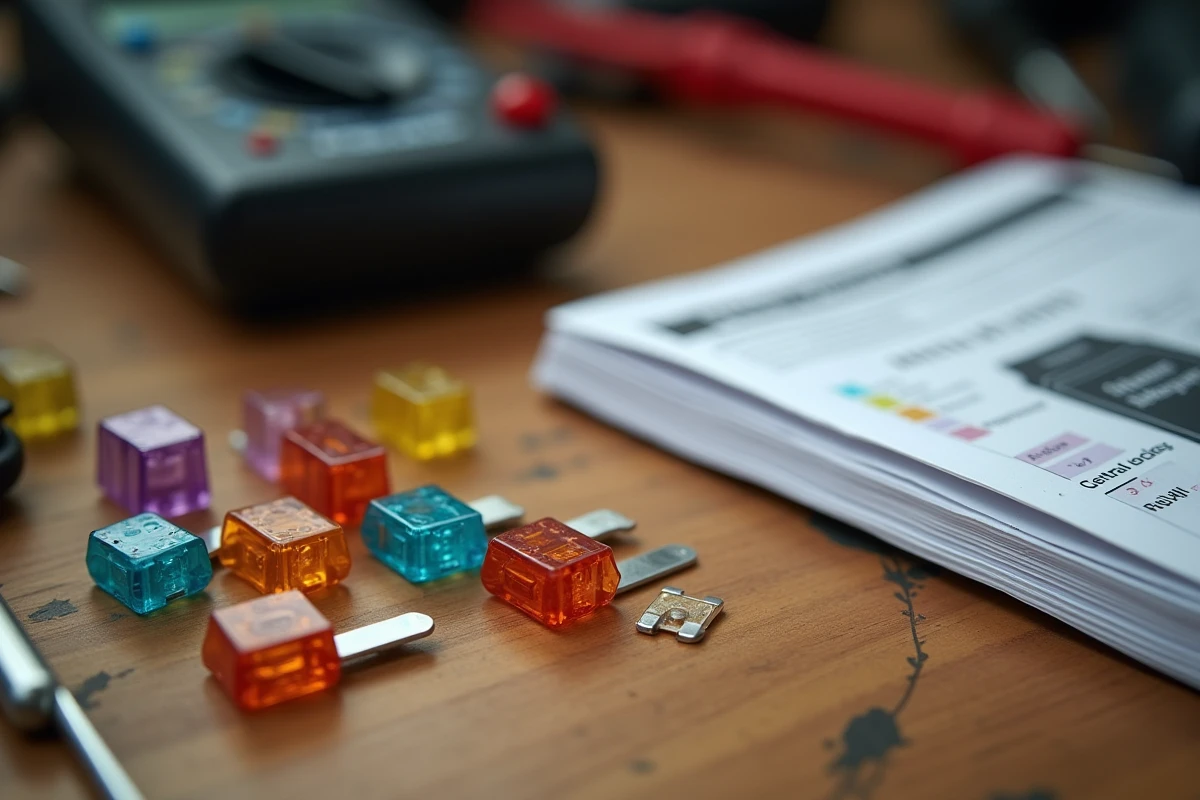
Replacement procedure
The replacement itself is simple, but a few common mistakes should be avoided. Here’s the procedure to follow:
- Turn off the ignition and remove the key from the ignition switch (or the card if the vehicle is in keyless mode) before any manipulation in the fuse box
- Extract the fuse with the plastic pliers provided in the fuse box, never with metal pliers that could create a short circuit
- Always replace with a fuse of the same amperage: a higher rating would no longer protect the circuit and could damage the central locking module or wiring
- Immediately test the locking with the remote and with the interior button to ensure all doors respond
New fuse and central locking still down: avenues to explore
If the replacement fuse blows immediately or if the central locking still doesn’t respond after the change, the fuse is likely not the cause but the symptom. A fuse that repeatedly blows indicates a short circuit downstream, often in the wiring harness of a door (the cable passages in the hinges wear over time) or in a stuck lock actuator.
Before going further, check two quick things: the condition of the remote control battery (a weak battery sends a signal too weak to trigger the receiver) and the voltage of the vehicle’s battery. A battery below its nominal threshold can prevent the BSI/BCM module from functioning properly, which mimics exactly the symptoms of a blown fuse.
Feedback varies on this point, but on some models, simply disconnecting the battery for a few minutes is enough to reset the electronic module and restore central locking functionality. If nothing changes after these checks, the diagnosis requires a fault code reading tool connected to the vehicle’s OBD port, which points precisely to the faulty component.
The central locking fuse remains the first element to check in the face of a silent central locking system. Its replacement costs almost nothing and takes only a few minutes. But when the problem persists, the electronic avenue (BSI module, door wiring, actuator) requires appropriate tools and, in most cases, the intervention of a professional automotive electrician.